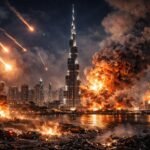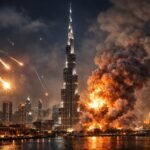
Officials said the evacuation was a precautionary step. There was no confirmed direct strike on the tower. However, security agencies acted quickly amid concerns that falling debris from intercepted missiles could pose a risk to people inside and around the structure.
The incident unfolded as tensions escalated sharply in the Gulf.
What Happened
Residents reported hearing loud blasts in different parts of Dubai. Videos circulating online showed streaks in the night sky and flashes that appeared to be missile interceptions.
Authorities moved fast.
Police secured key areas. Emergency services were deployed. Roads around Downtown Dubai were cleared. Officials instructed people inside the Burj Khalifa to vacate the building in an orderly manner.
The tower, which stands 828 metres tall and attracts thousands of visitors daily, was cleared as a safety measure.
There were no immediate reports of structural damage to the building.
Why Dubai Took Action
The evacuation followed missile and drone activity in the region after heightened geopolitical tensions involving Iran, the United States and Israel.
Regional airspace restrictions were imposed as a precaution. Flights at Dubai International Airport faced disruption. Airlines delayed or rerouted several services while authorities assessed the situation.
In Abu Dhabi, officials confirmed that debris from intercepted missiles fell in a residential area. Casualties were reported there. The UAE strongly condemned the attacks and called them a dangerous escalation.
Dubai authorities stressed that public safety remained the top priority.
A Rare Moment for a “Safe Haven” City
Dubai has long positioned itself as one of the safest global hubs in the Middle East. It hosts millions of tourists each year. It is home to global businesses, financial institutions, and expats from over 200 nationalities.
That is why the evacuation of the world’s tallest building stood out.
For many residents, hearing explosions in the distance felt surreal. Social media filled with videos and first-hand accounts. Some described seeing flashes in the sky. Others reported sirens and heavy security presence in key districts.
Authorities urged the public to rely only on official updates and avoid spreading unverified information.
Airspace and Business Impact
Dubai’s economy runs on connectivity. Aviation is central to that.
Temporary airspace restrictions disrupted flight schedules across the region. Several Gulf countries reviewed airspace protocols as a precaution.
Markets reacted cautiously. Oil prices showed volatility as investors assessed the risk of further escalation in the region.
While authorities restored order quickly, the message was clear: regional tensions can have immediate and visible impact, even in cities known for stability.
What Authorities Are Saying
Officials reiterated that the Burj Khalifa evacuation was preventive. There was no confirmed hit on the building.
Security forces remain on alert. Air defence systems across the region continue to monitor potential threats.
The UAE leadership emphasized restraint and called for de-escalation.
The Bigger Picture
This incident highlights how interconnected global security has become.
A strike in one part of the region can ripple across borders within hours. Cities that are economic hubs are also strategic targets because of their global visibility.
Dubai responded with speed and coordination. Evacuations were orderly. Emergency teams acted swiftly. Communication channels remained active.
But the psychological impact is harder to measure.
For a city often described as a symbol of ambition and safety, the sight of defensive action in its skies marked a significant moment.
What Happens Next
Authorities have not announced any long-term closures related to the Burj Khalifa. Operations are expected to resume once security assessments conclude.
Airlines continue to monitor airspace advisories. Businesses are watching developments closely.
For now, life in Dubai is gradually returning to normal.
Yet the episode serves as a reminder: even the most modern skylines are not insulated from regional conflict.
And when tensions rise, precaution becomes policy.