
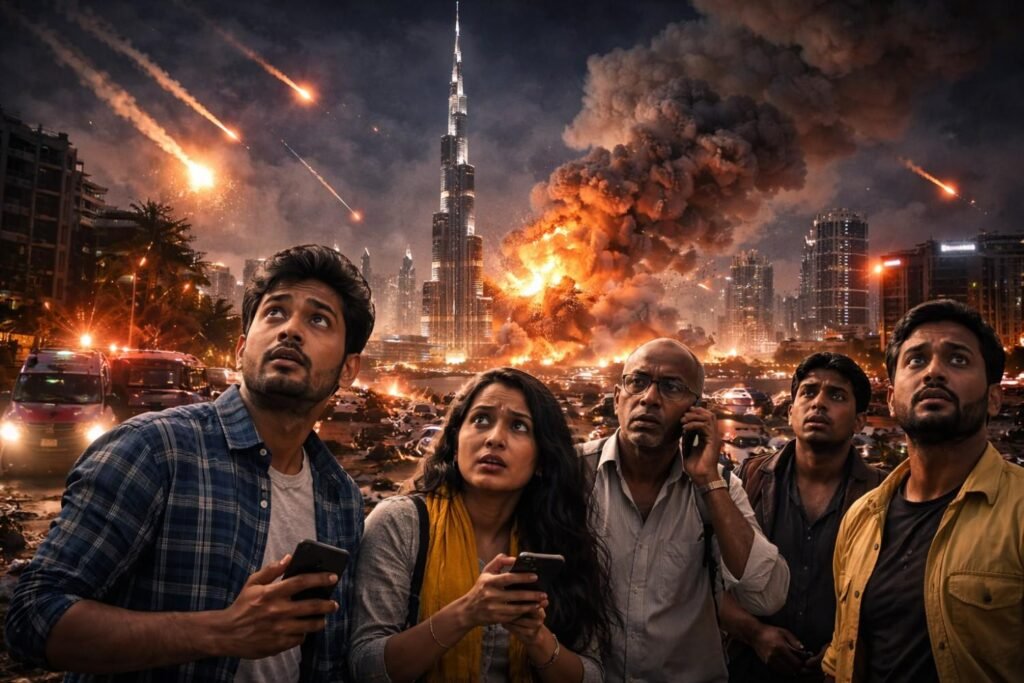
When tensions rise in the Gulf, Indians feel it almost immediately.
Dubai is not just another global city. For India, it is family, business, jobs, and opportunity rolled into one. So when reports emerged of missile activity and security alerts in Dubai, the question many asked was simple:
What does this mean for Indians?
Let’s break it down.
1. Safety of 3.5+ Million Indians in the UAE
The UAE is home to over 3.5 million Indians. It is the largest expatriate community there.
Many work in construction, retail, hospitality, healthcare, aviation, and finance. Others run businesses. Thousands live in and around Dubai’s key districts.
When security threats emerge, Indian families worry first about safety. Parents call their children. Spouses check in. WhatsApp groups light up.
Even if there is no direct hit in residential areas, fear spreads fast.
The Indian Embassy usually issues advisories. Authorities ask people to stay calm and follow official updates. But uncertainty creates stress.
For Indians in Dubai, stability is everything.
2. Jobs and Business Impact
Dubai is a major employment hub for Indians.
If tensions continue, sectors like aviation, tourism, hospitality, and real estate could slow down. These industries employ lakhs of Indians.
Flight disruptions affect airline staff, ground workers, travel agents, and logistics companies. Hotel bookings may dip if tourists postpone trips.
For Indian entrepreneurs in Dubai, uncertainty can affect sales, imports, exports, and cash flow.
Even short-term instability impacts daily earnings for many blue-collar workers who depend on regular work hours.
3. Remittances to India
Indians in the UAE send billions of dollars back home every year.
Kerala, Tamil Nadu, Uttar Pradesh, and several other states depend heavily on Gulf remittances.
If jobs get affected or salaries are delayed, families in India feel the impact quickly. Monthly household budgets depend on that money. Education fees, EMIs, medical expenses — all rely on steady transfers.
A prolonged crisis in the region could disrupt this financial lifeline.
4. Air Travel and Student Movement
Dubai is a key transit hub for Indians.
Thousands of students and professionals fly through Dubai every week. If airspace restrictions increase, flights may get delayed or rerouted. Ticket prices could rise.
This affects students traveling abroad, families planning visits, and business travelers attending meetings.
For many Indians, Dubai is not the final destination. It is the gateway.
Any disruption there creates a ripple effect globally.
5. Oil Prices and Indian Economy
Regional conflict in the Gulf often pushes oil prices up.
India imports most of its crude oil. Higher oil prices mean higher fuel costs. That can increase transport costs, inflation, and pressure on household budgets.
So even Indians who have never visited Dubai can feel the impact at the petrol pump.
Energy security becomes a national concern when tensions rise in the Gulf.
6. Emotional and Psychological Impact
Beyond economics, there is emotion.
Millions of Indian families have at least one member working in the Gulf. Dubai feels close. Familiar. Safe.
Any attack challenges that perception.
Parents in India lose sleep. Workers abroad feel anxious. Social media spreads both news and rumors.
In times like this, clarity matters more than noise.
The Bigger Picture
India and the UAE share strong diplomatic and economic ties. Both countries value stability.
For Indians, the key concerns remain clear:
- Safety
- Job security
- Smooth travel
- Stable remittances
- Controlled oil prices
The situation may stabilize quickly. Gulf nations have strong security systems and rapid response capabilities.
But this moment is a reminder.
When geopolitics shifts in the Middle East, Indians — whether in Dubai or Delhi — feel the impact faster than most.
And that is why every development in the Gulf matters deeply to India.