

Your first email from your Dubai office arrives. “Please note our Ramadan working hours will be 9am to 3pm starting next week.”
You stare at your screen confused. That’s only six hours. What about your project deadlines? Your client meetings? Your carefully planned work schedule?
Welcome to Ramadan working hours. They confuse every new expat. They stress out business travelers. They require major adjustments from everyone.
But once you understand how the system works, you’ll realize it’s not chaos. It’s structured. Legal. And actually manageable if you know what to expect.
Let me walk you through everything about working during Ramadan in Dubai so you’re prepared, not panicked.
The Official Working Hours That Just Got Announced
Ramadan 2026 is expected to start on February 19. The UAE government just announced the official working hours for both sectors.
Government employees work these hours:
- Monday to Thursday: 9am to 2:30pm
- Friday: 9am to 12pm
That’s 5.5 hours on weekdays and 3 hours on Friday. Government offices essentially run half-days throughout the entire month.
Private sector employees get a different deal:
- Daily working hours reduce by 2 hours
- Standard 8-hour workday becomes 6 hours
- Standard 9-hour workday becomes 7 hours
The Ministry of Human Resources and Emiratisation mandates this reduction. It’s not optional for employers. It’s law under Cabinet Resolution No. 1 of 2022.
Here’s what many people miss. The two-hour reduction applies to everyone in the private sector. Muslim employees. Non-Muslim employees. Fasting employees. Non-fasting employees. Your religion doesn’t matter. The law covers all private sector workers.
Your salary doesn’t get reduced during Ramadan. You work fewer hours but receive full pay. Employers cannot cut wages because of shortened working hours.
What This Actually Means for Your Workday
Theory is one thing. Reality is different.
Most private companies shift their start times during Ramadan. Some begin at 8am instead of 9am. Others start at 9am but end at 3pm instead of 5pm or 6pm.
Your specific schedule depends on your company’s decision. Employers have flexibility in how they structure the reduced hours. Some prefer earlier starts with earlier finishes. Others maintain normal start times with much earlier end times.
Companies must inform employees of the exact Ramadan schedule before the month begins. Check your email. Ask your manager. Don’t assume anything.
Free zones like DIFC and ADGM follow different rules. In these areas, only Muslim employees who are fasting get reduced hours. Non-Muslim staff might work regular schedules. Check your employment contract if you work in a free zone.
The Friday schedule creates interesting situations. Government offices close at noon. Private sector offices might close around 1pm or 2pm depending on their schedule. This makes Friday essentially a short half-day across Dubai.
Flexible and remote work options expand during Ramadan. Companies can implement work-from-home arrangements within the daily hour limits. The Ministry encourages this flexibility. Many businesses embrace it.
Government entities can allow up to 70% of staff to work remotely on Fridays during Ramadan in Dubai. This reduces office crowding and gives employees more flexibility on the shortest workday.
How Banks and Government Services Adjust
Banks follow their own Ramadan schedules that differ from other private businesses. Most banks open around 8:30am or 9am. They typically close between 2pm and 3pm.
Expect longer lines at banks during Ramadan. Everyone tries to complete banking tasks in the shortened window. The lunch hour rush becomes more concentrated. Plan accordingly.
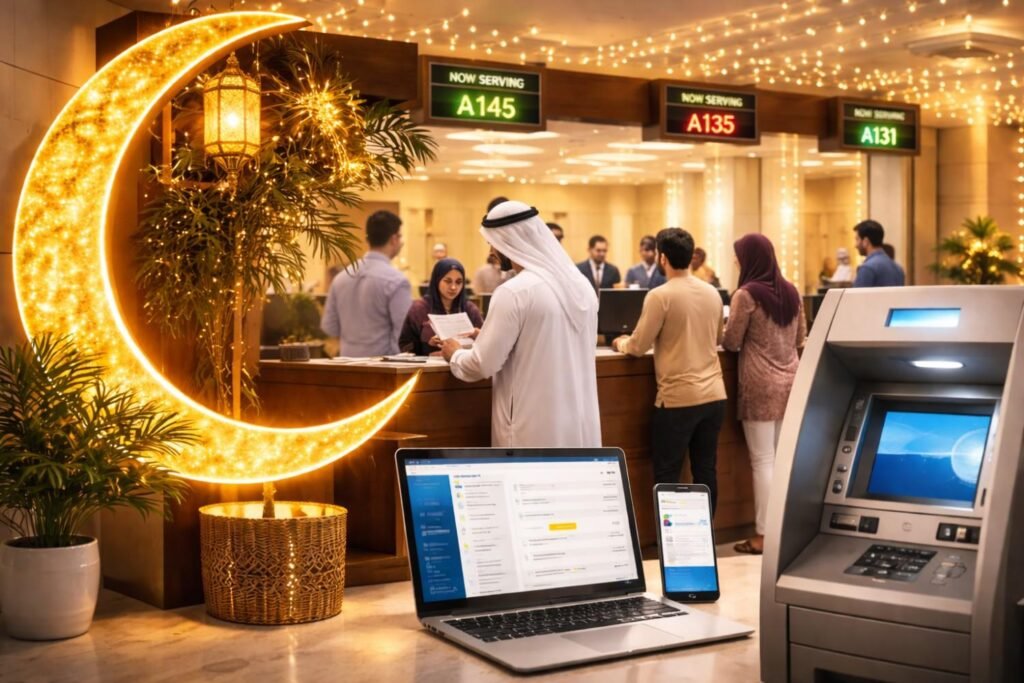
ATMs operate 24/7 as always. Online banking faces no restrictions. If you can handle transactions digitally, that’s your best option during Ramadan.
Government service centers follow the official government schedule. RTA customer service centers close at 2:30pm on weekdays and noon on Fridays. Immigration offices follow similar hours. Court operations run on the reduced schedule.
Post offices adjust to Ramadan timing. Emirates Post branches typically operate from 8am to 2pm during the holy month. Check specific locations as times can vary slightly.
Customer service hotlines often maintain regular hours even when physical offices close early. You can still call for information or support outside reduced office hours.
Municipality offices and permit centers follow government schedules strictly. If you need approvals or permits during Ramadan, arrive early. These places get busy fast with everyone trying to complete business in limited hours.
School Hours That Affect Your Family
Private schools in Dubai reduce hours significantly during Ramadan. The Dubai Knowledge and Human Development Authority (KHDA) sets guidelines for all private schools.
Most schools follow one of these patterns:
- Start at regular time but dismiss 1-2 hours earlier
- Start later but maintain afternoon dismissal time
- Reduce both start and end times
Your child’s specific school will communicate their Ramadan schedule. Schools must notify parents well in advance. Check your email and school communication platforms.
Kindergarten and early years programs often have different schedules than primary and secondary schools. Younger students typically finish even earlier during Ramadan.
School buses adjust pickup and dropoff times to match the new schedules. Update your family routine accordingly. Traffic patterns shift when school dismissal times change.
After-school activities and sports programs might be cancelled or rescheduled during Ramadan. Clubs and teams often move practices to evening hours after sunset. Check with your child’s activity coordinators.
University schedules vary by institution. Some reduce class hours. Others adjust timetables but maintain total instructional time. Contact your university for specific policies.
The Productivity Reality Nobody Discusses
Shortened hours don’t automatically mean proportionally less work. Companies still expect projects to progress. Deadlines remain deadlines.
Many businesses increase efficiency during Ramadan working hours. Meetings become shorter and more focused. The “quick chat” culture reduces. People get to the point faster because time is precious.
Some companies experience productivity dips despite good intentions. Fasting employees struggle with energy in late afternoon. Non-fasting employees feel awkward eating or drinking around fasting colleagues. The whole dynamic shifts.
Smart companies adapt their work culture during Ramadan. They schedule important meetings earlier in the day. They avoid 1pm to 2pm slots when everyone’s energy drops. They allow more flexibility for work completion.
Email and message response times can slow during Ramadan. People leave offices at 2pm or 3pm. They might not check work communications again until evening. Factor this into your expectations.
International business coordination gets tricky. Your Dubai office finishes at 2:30pm. Your New York colleagues start their day at 2pm Dubai time. Your overlap window becomes tiny. Video conferences require creative scheduling.
Client-facing businesses struggle most with reduced hours. Customers still have needs outside the shortened service window. Finding the balance between legal requirements and customer service creates challenges.
Evening Work Culture During Ramadan
Here’s what surprises many newcomers. Work doesn’t stop when offices close at 2pm or 3pm. It just shifts.
Many professionals check emails and messages after iftar. The period from 8pm to 11pm sees significant work activity. People catch up on tasks. Respond to communications. Complete projects.
Some companies hold meetings after iftar. Teams gather at 8pm or 9pm for discussions that couldn’t happen during the short daytime window. This especially applies to businesses with international teams.
The evening work culture isn’t official or mandatory. It happens organically. Professionals manage workloads by splitting attention between daytime and evening hours.
If you’re working with Dubai colleagues during Ramadan in Dubai, understand this pattern. Your 3pm email might not get answered until 9pm. That’s normal, not rude.
Coworking spaces see interesting patterns during Ramadan. They’re relatively empty during traditional office hours. Then they fill up again after 8pm with freelancers and entrepreneurs working evening shifts.
What Tourists and Business Travelers Must Know
Business travel to Dubai during Ramadan requires different planning. Your standard 9am meeting won’t work. Your afternoon presentation needs rescheduling.
Book early morning meetings when possible. The 9am to 11am window offers maximum productivity. Everyone’s fresh. Offices are fully staffed. Energy levels are high.
Avoid scheduling anything between 1pm and 3pm. Government offices close. Private offices start clearing out. Even restaurants and cafes in business districts become scarce.
If you must meet after standard hours, suggest post-iftar timing. Many business people are happy to meet at 8pm or 9pm during Ramadan. Evening meetings over coffee or traditional Ramadan beverages work well.
Dress codes matter more during business meetings in Ramadan. Review what to wear in Dubai during Ramadan before your trip. Conservative professional attire shows respect for the holy month.
Hotel business centers maintain longer hours than regular offices. If you need workspace, facilities, or meeting rooms outside traditional hours, hotels provide solutions.
Coworking spaces like WeWork, Nook, and Astrolabs adjust their hours during Ramadan. Many stay open later in the evening. Check specific locations for their Ramadan schedules.
Shopping and Services That Extend Hours
While offices close early, retail does the opposite. Malls and shops extend hours significantly during Ramadan.
Most major malls open around 10am or 11am. But they stay open until midnight or 1am. Some extend even later on weekends. The evening shopping scene becomes vibrant.
Food courts and restaurants in malls adjust around iftar timing. Many close briefly from 6pm to 8pm so staff can break their fast. Then they reopen and serve until midnight or later.
If you’re planning Dubai shopping during Ramadan, the evening hours offer the best experience. Sales, energy, and selection all peak after 8pm.
Grocery stores and supermarkets stay open late. Carrefour, Lulu, and other major chains often operate until midnight or 1am. They stock up on Ramadan specialties and experience heavy traffic in evening hours.
Pharmacies maintain extended hours during Ramadan. Many 24-hour pharmacies continue operating round the clock. Health services don’t reduce availability.
Restaurants follow varied schedules. Some close during daytime. Others stay open but don’t serve food openly. Most come alive after sunset with special iftar and suhoor menus.
Entertainment venues like cinemas adjust show times. Most screenings start after iftar. Late night shows at 11pm or midnight become common during Ramadan.
Healthcare and Emergency Services
Hospitals and clinics maintain full operations during Ramadan. Emergency services never reduce hours. Medical care remains available 24/7.
Outpatient clinics and specialist appointments might adjust scheduling. Some doctors see patients earlier in the day. Others add evening slots. Call ahead to confirm appointment times during Ramadan.
Pharmacies in hospitals stay open continuously. Independent pharmacies might reduce hours slightly but most major chains maintain long opening times.
Dental clinics often prefer morning appointments during Ramadan. Afternoon procedures become less comfortable for fasting patients and practitioners. Book early slots if possible.
Laboratory testing centers usually open early and close early during Ramadan. Blood work and medical tests happen predominantly in morning hours.
Mental health services and counseling continue uninterrupted. Therapists and counselors maintain appointment schedules, though timing might shift to accommodate Ramadan hours.
Transportation and Commuting Changes
Dubai Metro and tram services continue regular schedules during Ramadan. Public transport doesn’t reduce frequency or operating hours.
Traffic patterns shift dramatically. Morning rush hour comes slightly earlier as people start work earlier. Evening rush spreads out over longer periods.
The 2pm to 3pm window sees heavy traffic as offices close and people head home. Roads around government districts become particularly congested.
Evening traffic intensifies around iftar time. Between 6pm and 8pm, roads clear noticeably as people rush home to break their fast. This creates an odd quiet period in typically busy areas.
After iftar, around 8pm onwards, traffic surges again. People head to malls, restaurants, and social gatherings. Evening rush hour extends much later than usual.
Taxis and ride-sharing remain available throughout Ramadan. Uber and Careem operate normally. You might see surge pricing during peak times like right before and after iftar.
Public parking rules adjust during Ramadan. Many paid parking zones offer free parking during iftar hours, roughly 6:30pm to 8:30pm. Parkin, Dubai’s parking operator, typically adjusts their enforcement during these times.
RTA Salik toll gates continue charging as normal. Road tolls don’t pause or reduce during Ramadan.
Remote Work Trends During Ramadan
Many companies embrace remote work more fully during Ramadan. The reduced office hours make work-from-home arrangements more attractive.
Tech companies and digital businesses often go fully remote during Ramadan. Teams work distributed hours. Collaboration happens via video calls and chat platforms.
Results-oriented work environments thrive during Ramadan. When hours are compressed, output matters more than office presence. Companies focus on deliverables rather than seat time.
Freelancers and contractors often prefer Ramadan for focused work. Fewer meetings. Less office politics. More time for deep concentration. Many accomplish significant projects during the month.
Coworking memberships see interesting patterns. Some people use them more during Ramadan for structure and focus. Others work entirely from home and pause memberships.
Digital nomads find Ramadan in Dubai appealing. Lower hotel rates. Good weather. Less crowded attractions. The work environment supports productivity despite shortened official hours.
Legal Rights and Employer Obligations
UAE labor law protects workers during Ramadan. Employers must follow specific rules.
The two-hour reduction is mandatory for all private sector employees. Employers cannot refuse this reduction. They cannot pressure employees to work full hours.
Salaries cannot be reduced during Ramadan. You receive full monthly pay regardless of working fewer hours. Any salary reduction violates labor law.
Overtime during Ramadan follows standard rules. If your company requires work beyond the reduced hours, they must pay overtime rates. The shortened workday sets the baseline for overtime calculations.
Companies cannot fire or penalize employees for refusing to work beyond reduced Ramadan hours. Labor law protections apply throughout the month.
If your employer violates Ramadan working hour regulations, you can file a complaint with the Ministry of Human Resources and Emiratisation. The ministry takes these violations seriously.
Free zone employees should check their specific contracts. DIFC and ADGM have slightly different regulations regarding Ramadan hours, particularly for non-Muslim employees.
Tips for Thriving During Ramadan Work Hours
Accept that your work rhythm will change. Fighting it creates stress. Adapting makes life easier.
Start your day earlier during Ramadan. The morning hours offer peak productivity. Accomplish critical tasks before noon when energy levels drop.
Schedule important work for Sunday through Wednesday. These full workdays provide more flexibility than the abbreviated Thursday and Friday schedules.
Communicate proactively with colleagues and clients about Ramadan schedules. Set expectations early. Clarify availability windows. Prevent misunderstandings.
Use evening hours strategically. If you’re comfortable working after iftar, you gain significant productive time when others are offline.
Take advantage of the flexibility. Many companies care more about output than hours during Ramadan. Complete your responsibilities efficiently and enjoy the extra personal time.
Respect fasting colleagues even if you’re not fasting. Avoid eating or drinking obviously in shared spaces. Take lunch breaks away from your desk if possible.
Stay hydrated before and after fasting hours if you’re not fasting. The reduced schedule and changed routine can disrupt normal eating patterns. Maintain your health.
The Real Talk About Ramadan Work Life
Ramadan working hours feel strange initially. Your body clock gets confused. Your work routine disrupts. Your social schedule flips.
Give yourself the first week to adjust. Most people find their rhythm by week two. The month passes quickly once you adapt.
The shortened hours force prioritization. You learn what actually matters. Unnecessary meetings disappear. Time wasters become obvious. Many people become more efficient during Ramadan than regular months.
Work-life balance improves for many professionals. Leaving at 2pm or 3pm creates afternoon freedom rarely available in Dubai. Time for family. Exercise. Personal projects. Relaxation.
The communal aspect matters. Everyone adjusts together. You’re not alone in the confusion or adaptation. Colleagues support each other through the changes.
Some people love Ramadan working hours. Others count down to regular schedule resumption. Both reactions are valid. Your experience depends on your job, your life situation, and your flexibility.
After Ramadan: The Return to Normal
Ramadan ends with Eid al-Fitr, a three to four-day public holiday. After Eid, working hours return to standard schedules immediately.
The transition back feels abrupt. Suddenly your 6-hour workday becomes 8 or 9 hours again. Energy levels must readjust.
Many professionals report post-Ramadan productivity surges. The longer hours feel generous after a month of compressed schedules. Teams accomplish significant work in the weeks following Ramadan.
Don’t schedule major projects for the final Ramadan week or first week after Eid. These transition periods see reduced productivity as people adjust.
Plan ahead for the month after Ramadan. Catch up on projects delayed during the holy month. Reconnect with clients who were less accessible. Resume normal business development activities.
Your Ramadan Work Survival Kit
Understanding working hours during Ramadan in Dubai removes the mystery and anxiety. Yes, hours reduce. Yes, schedules change. But life continues. Work gets done. Business functions.
The key is adjustment, not resistance. Embrace the different rhythm. Respect the cultural context. Communicate clearly with colleagues and clients.
Whether you’re a tourist planning business meetings, an expat starting your first Ramadan, or a long-time resident helping new colleagues, knowing these details matters.
Ramadan working hours aren’t obstacles. They’re just different. And different becomes normal surprisingly quickly.
The month passes. Work continues. Projects complete. Deadlines get met. Dubai keeps moving forward, just on a different schedule for 29 or 30 days.
Now you know what to expect. Prepare accordingly. Adjust proactively. You’ll handle Ramadan working hours just fine.