
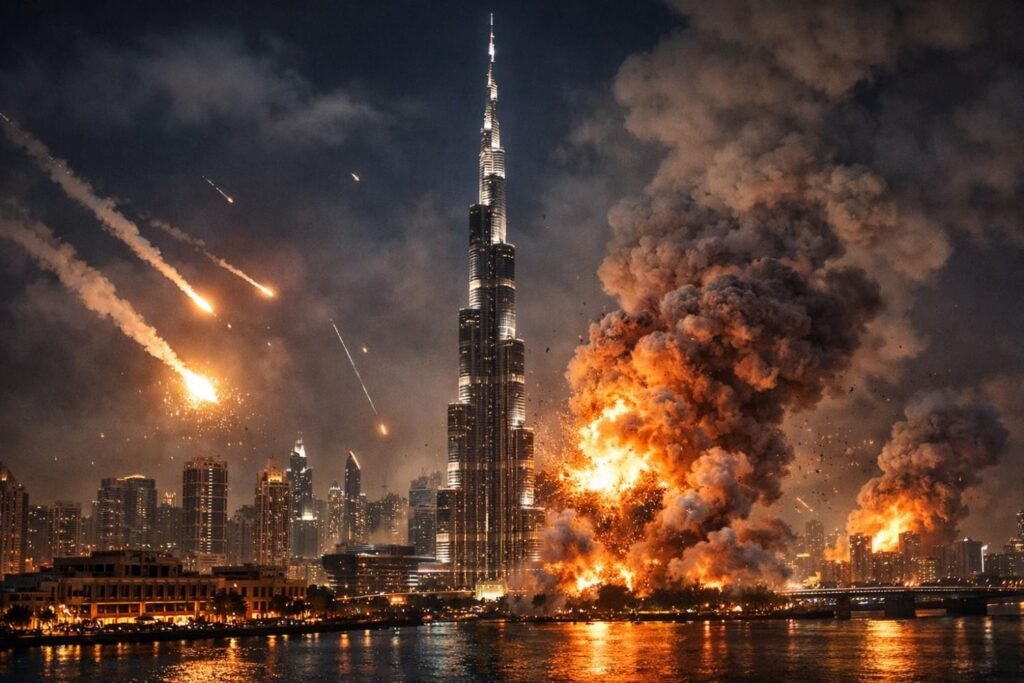
Saturday morning started like any other day in Dubai.
Then came the explosions.
Loud pops overhead. Windows shaking. Flashes of light across the sky. People looking up, confused, scared.
The UAE—the Middle East’s beacon of stability—was under missile attack.
And nothing would feel the same again.
The Attack That Changed Everything
Here’s what happened on February 28, 2026:
Iran launched ballistic missiles at the UAE. Not just one or two. Multiple missiles targeting both Abu Dhabi and Dubai.
The UAE’s air defense systems intercepted several missiles. But not all of them.
In Abu Dhabi, missile debris fell on a residential area. One person—a Pakistani national—was killed. Others were injured.
Dubai residents heard explosions throughout the day. From Barsha to Motor City, the sounds of interception echoed across the city.
This wasn’t a drill. This wasn’t an accident.
This was Iran sending a very clear message.
Why Did Iran Target the UAE?
Let me be direct: the UAE wasn’t the primary target.
The United States was.
Here’s the timeline that led to this moment:
The U.S. and Israel launched “Operation Epic Fury”—a massive coordinated attack on Iran. They struck military installations, government symbols, and intelligence targets across Tehran and other Iranian cities.
President Trump announced the operation, telling Iranians to “take over your government.”
Iran’s response? Strike back at every U.S. military asset in the region.
The problem? Those assets are hosted in Gulf countries. Including the UAE.
The Islamic Revolutionary Guard Corps (IRGC) made their position clear: any country hosting U.S. military bases is a legitimate target.
The UAE hosts American military facilities. So does Bahrain. Qatar. Kuwait. Jordan.
All of them were hit.
The Ripple Effect Was Instant
Within hours, the entire region went into lockdown mode.
Dubai International Airport—the world’s busiest international airport—suspended all flights. Indefinitely.
Al Maktoum International Airport? Same story.
Emirates, the world’s largest long-haul carrier, grounded its entire fleet. FlyDubai followed suit.
Passengers were told: Don’t come to the airport. Stay home. Check with your airline.
The UAE’s airspace closed. So did Qatar’s. And Kuwait’s. And Bahrain’s.
By evening, over 230 flights across the Middle East were cancelled. That’s nearly 7% of all scheduled flights.
The business hub of the world had come to a standstill.
The Bigger Picture: A Region on Fire
This attack isn’t happening in isolation.
Let’s zoom out for a moment.
The Middle East has been a powder keg for months. The U.S.-Israel operation on Iran wasn’t a one-off strike—it’s a multi-week campaign, according to defense experts.
Failed diplomatic talks in Switzerland and Oman preceded the strikes. Oman’s Foreign Minister had been optimistic just hours before the attack, saying peace was “within reach.”
Then the bombs dropped.
Iran retaliated by targeting U.S. bases across the region. Israel faced another barrage of missiles. Air raid sirens wailed from Tel Aviv to Manama.
Syria reported casualties from missile strikes. Iraq closed its airspace. Erbil Airport shut down after being targeted twice.
This isn’t just a U.S.-Iran conflict anymore.
This is a regional war.
What Does This Mean for Dubai?
For years, Dubai positioned itself as the Switzerland of the Middle East.
Neutral. Safe. Open for business.
You could be from anywhere, believe anything, and do business with anyone. That was the Dubai promise.
But this attack changes the equation.
When missiles target your airspace, when residents hear explosions, when airports shut down—that safe haven narrative takes a hit.
The UAE government responded strongly. They condemned Iran’s “blatant violation” of sovereignty. They called the attacks a breach of international law.
They also made something else clear: “We reserve our full right to respond.”
Translation: This isn’t over.
The Economic Stakes Are Enormous
Dubai isn’t just a city. It’s a global logistics hub.
Over 100 airlines use Dubai as a connection point. Millions of passengers transit through DXB every month. Billions in trade flow through Dubai’s ports and airports.
When that system shuts down—even temporarily—the economic impact is massive.
Airlines face “operational inefficiency.” That’s corporate speak for: rerouting costs money, delays cost money, war-risk insurance premiums go up, and fuel costs spike.
European airlines can’t use Russian airspace (thanks to Ukraine war). They rely on Middle East corridors. Now those corridors are under threat.
Cargo disruptions follow. Trade slows down. Investors get nervous.
The UAE knows this. That’s why they intercepted those missiles. That’s why they closed airspace as a “precautionary measure.”
They’re trying to protect what they’ve built.
The Human Cost
Let’s not forget: real people are living through this.
Families heard explosions and didn’t know what was happening. Residents stayed away from windows, unsure if more strikes were coming.
One man lost his life in Abu Dhabi. A Pakistani national working in the UAE, contributing to the economy, building a life.
Gone because of geopolitics he had nothing to do with.
The UAE government warned residents: stay away from shrapnel and suspicious objects. Don’t touch debris.
That’s the reality now.
What Happens Next?
Nobody knows for sure.
But here’s what we do know:
The U.S. operation in Iran is ongoing. More strikes are expected. Iran has promised “relentless” retaliation. Gulf countries are on high alert. Saudi Arabia pledged “all its capabilities” to support affected nations.
The UAE has options. They can strengthen air defenses. They can reconsider their relationship with U.S. military presence. They can push harder for diplomatic solutions.
But they’re stuck between a rock and hard place.
They want good relations with the U.S. They also don’t want to be collateral damage in someone else’s war.
Welcome to geopolitics in 2026.
The Bigger Question: Can the Gulf Stay Neutral?
For decades, Gulf nations tried to play it smart.
They maintained ties with the West while avoiding direct confrontation with Iran. They built economic powerhouses. They attracted global investment.
But neutrality has limits.
When you host U.S. military bases, you become part of the equation. When regional powers clash, you can’t just watch from the sidelines.
Iran’s message was clear: hosting American assets makes you a target.
The Gulf countries now face a choice: push out U.S. military presence and risk losing American protection, or keep the status quo and remain vulnerable to Iranian strikes.
Neither option is easy.
Dubai has always been about ambition, growth, and defying odds.
But even the most ambitious city can’t escape geography.
The UAE sits in one of the world’s most volatile regions. That’s always been true. What’s changed is the scale of conflict.
This attack was a wake-up call.
Not just for the UAE, but for everyone who believed the Middle East could be business-friendly and conflict-free at the same time.
The skies over Dubai lit up on Saturday. Not with fireworks or celebrations.
With the harsh reality that no place—no matter how modern, how prosperous, how ambitious—is immune to the consequences of regional war.
The question now isn’t if more attacks will come.
It’s how the region responds when they do.
What are your thoughts on the situation? Have you or your business been affected by the flight disruptions? Let’s discuss in the comments.