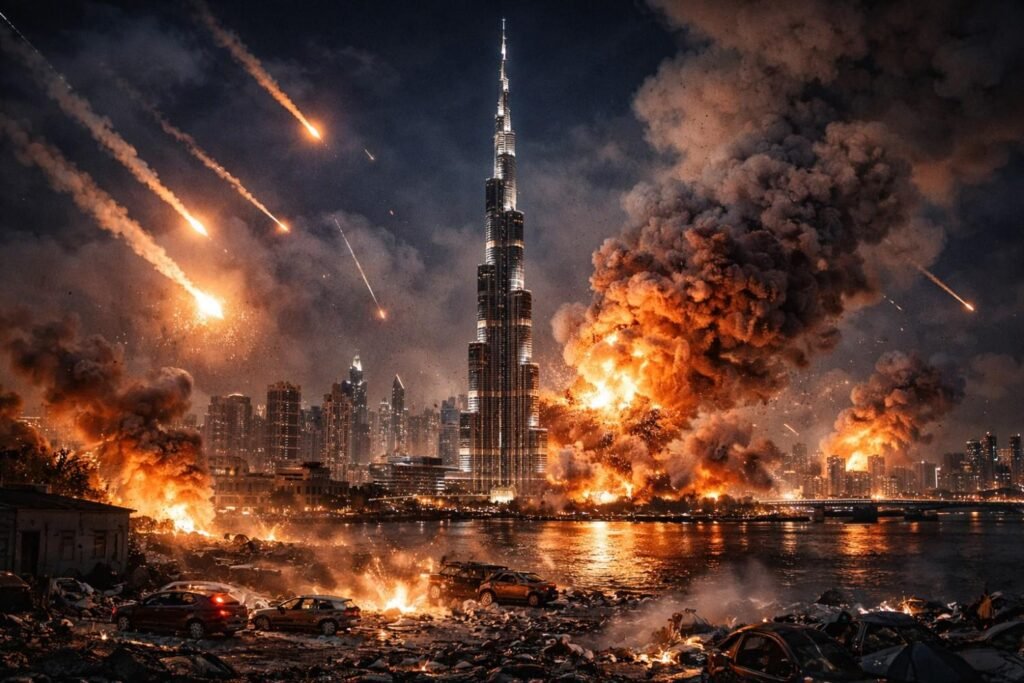
The Burj Khalifa—2,722 feet of glass and steel piercing the clouds—has seen a lot.
Record-breaking visitors. New Year’s fireworks. Luxury events.
But Saturday night, it saw something else entirely.
Evacuation orders.
Because Iranian drones were circling overhead.
When Luxury Became a Target
Let me paint you the picture.
The Fairmont Hotel on Palm Jumeirah—one of Dubai’s most exclusive addresses—was hit. Fire erupted. Black smoke billowed into the sky.
The Burj Khalifa, the world’s tallest skyscraper, was evacuated as explosions erupted nearby.
Residents across Dubai heard booms. Saw flashes. Felt the ground shake.
This wasn’t a movie set. This was real life in one of the world’s most glamorous cities.
Iran’s “Operation True Promise 4” had arrived in the UAE.
The Drones That Changed Everything
Iran deployed Shahed-136 loitering munitions—kamikaze drones designed to explode on impact.
They’re cheap, slow, and deadly effective.
Videos showed drones approaching Dubai’s landmarks. Air defense systems engaged. Explosions lit up the sky.
But not every threat was stopped.
The Fairmont Hotel was hit—whether from a direct strike or falling debris remains unclear. Either way, a five-star hotel was on fire.
Why Dubai? Why Now?
Dubai didn’t ask for this fight.
But it’s hosting one of the combatants.
Abu Dhabi houses Al Dhafra airbase, a major U.S. military installation that was Iran’s primary target.
Iran’s message to the UAE: if you host American forces, you become part of the battlefield.
This attack came as Iran’s response to U.S.-Israel strikes on Tehran. Children died in those strikes. Civilians were killed. And Iran decided to hit back—not just at Israel, but at every U.S. base in the region.
Kuwait, Qatar, Bahrain, Jordan, Saudi Arabia—all faced Iranian missiles and drones.
The UAE just happened to be home to two of the world’s most recognizable landmarks.
The Human Reality Behind the Headlines
Let’s talk about what this actually means for people.
Tourists who booked luxury vacations in Dubai suddenly found themselves fleeing hotel lobbies.
Residents received emergency alerts on their phones: “Potential missile threats. Take shelter immediately. Stay away from windows.”
One Pakistani national died from falling shrapnel in Abu Dhabi. A man working, living, contributing—gone because of a conflict he had nothing to do with.
Authorities are now asking people not to film or share videos. They want to control the narrative. They want to maintain the image of safety.
But you can’t unsee what people have already witnessed.
The Technology of Modern Warfare
The Shahed-136 changed the game.
It’s cheap. Easy to deploy. Hard to stop.
UAE’s defense network includes Patriot PAC-3, THAAD, and Barak systems—some of the most advanced military hardware on the planet.
And still, threats got through.
That’s modern warfare. A few thousand-dollar drones can terrorize entire cities.
What This Means for Dubai’s Future
Dubai built its reputation on being different.
Safe. Neutral. Open for business while the region burned around it.
That narrative is now under serious question.
When your most iconic building gets evacuated during a drone attack, when luxury hotels catch fire from falling missiles, when airports shut down indefinitely—investors notice.
Tourists reconsider. Businesses assess risk. Insurance premiums go up.
The UAE government condemned the strikes as a “dangerous escalation and cowardly act.” They said they “reserve the right to respond.”
But what does that response look like?
Push out U.S. forces and lose American protection? Keep them and remain a target? There’s no easy answer.
The Bigger Picture
Iran hit six countries simultaneously. U.S. bases in Kuwait, Bahrain, Qatar, Saudi Arabia, the UAE, and Jordan all faced strikes.
This is coordinated. Strategic. Unprecedented.
Tehran’s message to Washington: your bases aren’t safe. Your allies aren’t off-limits.
Gulf nations are caught in the middle. They want American protection but don’t want to be battlegrounds.
You can’t have both anymore.
The Morning After
The fires are out now. The smoke has cleared.
But something fundamental has changed.
Dubai has always marketed itself as above the chaos. A place where East meets West peacefully. Where business happens regardless of politics.
Saturday night shattered that illusion.
The Burj Khalifa—a symbol of human achievement and ambition—became a symbol of vulnerability.
The Palm Jumeirah—an engineering marvel—became a target.
And the people of Dubai learned what residents of Tel Aviv, Baghdad, and Damascus have known for years:
No one is truly safe when regional powers go to war.
The question now isn’t whether more attacks will come. It’s how Dubai responds when they do.
Have you reconsidered travel plans to the UAE? How should Gulf nations balance security and neutrality? Share your thoughts.