I have been to Dubai many times. Each visit, the city looks different. New towers and roads. New neighbourhoods that did not exist two years before.
But what is coming between now and 2030 is not just new buildings. It is a whole new version of the city.
Dubai is not upgrading. It is rebuilding from the future backward.
Here are the seven projects that prove it.
1. Metro Blue Line: A New City Is Growing Underground
Right now, beneath the streets of Dubai, a 163-metre-long tunnel boring machine named Al Wugeisha is carving through the earth.
The Dubai Metro Blue Line spans 30 kilometres, with 14 stations, and is scheduled to open on 9 September 2029. The project is currently 20 percent complete, with more than 10,000 workers and over 500 engineers involved.
At full capacity, the line is projected to carry 200,000 daily riders by 2030 and 320,000 by 2040, with total projected benefits exceeding $15.4 billion by 2040, including a 20 percent reduction in corridor traffic congestion.
The Blue Line will connect with the Green Line at Creek Station and the Red Line at Centrepoint Station, while providing direct journeys to Dubai International Airport in about 20 minutes.
This is not just a metro line. It is the spine of a new Dubai that millions of people will live and work inside.
Follow live updates on the RTA Dubai website.
2. Al Maktoum Airport: The Biggest Airport Ever Built
Dubai already has one of the world’s busiest airports. Now it is building a bigger one.
Al Maktoum International Airport will be five times the size of the current Dubai International Airport. It will accommodate 400 aircraft gates and feature five parallel runways.
The first phase is on track for a 2032 launch, with AED 55 billion of contracts being awarded this year. When the project is complete, the airport will serve 260 million passengers annually.
To put that in context: Dubai International currently handles around 90 million passengers a year. This new airport will handle almost three times that.
Eventually, all Emirates flights will move there. The airport that made Dubai famous will hand over to something bigger.
3. Flying Taxis: Dubai Marina to Palm Jumeirah in 4 Minutes
This one still sounds like science fiction. It is not.
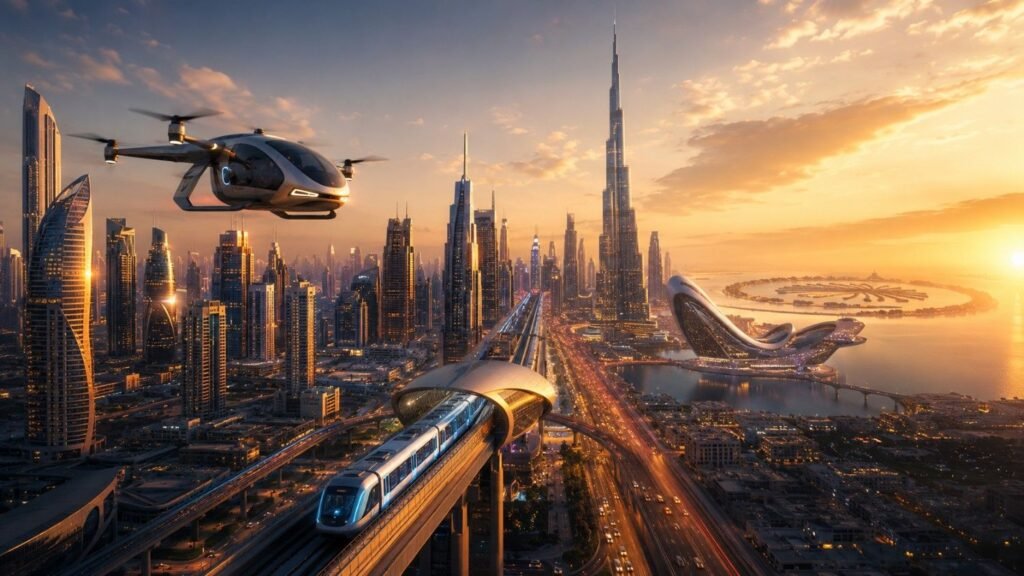
Dubai’s Roads and Transport Authority (RTA) has completed its first air taxi station near Dubai International Airport, a four-storey, 3,100-square-metre facility with two take-off and landing pads, charging infrastructure and passenger processing areas.
Dubai has become the first city in the world to launch commercial electric air taxi services. The initial routes connect Dubai Marina to Palm Jumeirah in just 4 minutes, with fares starting at AED 350.
The aim is for tickets to cost no more than a ride in an Uber Black, but taking roughly a third of the time a car would to get across the city.
You will be booking these through the RTA app. The same app you use for the metro.
Think about that for a second.
4. Dubai Museum of Art (DUMA): A Museum That Floats on Water
Most cities put art in buildings. Dubai is putting a building on water.
The Dubai Museum of Art will rise above the waters of Dubai Creek, designed by Pritzker Prize-winning Japanese architect Tadao Ando. It will stand five storeys above the Creek, featuring galleries across two levels, a restaurant and VIP lounge on the third floor, along with ground and basement levels.
The museum will be shaped like a seashell and inspired by Dubai’s pearl-diving legacy. A central entrance enables natural light to radiate around the area like a pearl’s brilliance, while a circular display space at its heart depicts unity and creativity.
DUMA forms a central pillar of Dubai’s Creative Economy Strategy 2030, reinforcing Dubai’s ambition to position itself as a global cultural capital.
This is Dubai’s answer to the Louvre Abu Dhabi. And honestly, it looks more interesting.
5. Palm Jebel Ali: Palm Jumeirah’s Bigger, Greener Sibling
Palm Jumeirah put Dubai on the map. On the other hand, Palm Jebel Ali is about to do it again.
The island spans 13.4 kilometres of land with 10.5 million square metres of development and 16 distinctive fronds, offering a total of 110 kilometres of coastline and 91 kilometres of beachfront. It will eventually be home to 35,000 families.
But this one is different from its older sibling. Palm Jebel Ali is planned with sustainability built into its core infrastructure. The project aims to source around 30 percent of its public energy needs from renewable power and will integrate smart city features, including efficient water management and electric vehicle charging across residential and public areas.
Nakheel has revealed that AED 750 million of major infrastructure works are scheduled for completion by the end of 2026.
This is the investment story everyone in Dubai is watching right now. First movers into Palm Jumeirah made fortunes. History rarely repeats itself exactly. But this is as close as it gets.
6. Expo City Dubai: The Smartest Neighbourhood in the World
Most cities tear down expo sites after the event ends. Dubai turned it into a living city.
Expo City Dubai sits on 483 hectares where Expo 2020 was held. It kept the Al Wasl dome, the UAE Pavilion, and the Terra sustainability pavilion. Then it built around them.
Expo City, designed as a blueprint for sustainable urban development, has established targets for its operational carbon footprint, including reductions of 45 percent by 2030 and 80 percent by 2040, ahead of achieving net zero by 2050.
It is now home to a free zone, startups, global companies, and a Green Innovation District, which is the UAE’s first. It is also one of the few places in Dubai built for walking, not driving.
If you visit Dubai before 2030, spend a morning here. It feels different from the rest of the city. Quieter. More considered. More human.
7. The Dubai Reefs: An Underwater City for the Ocean
Nobody expected this one.
Dubai is building the world’s largest ocean restoration project off its coast. The Dubai Reefs project covers 200 square kilometres of ocean. It includes artificial coral reefs, mangrove forests, and floating eco-resorts.
It will restore marine biodiversity, generate sustainable fisheries, and create a completely new kind of tourism. Guests will stay in floating lodges above active reef systems.
Dubai Reefs proves that the city’s future is not only vertical. It is environmental, sustainable, and ocean-connected.
For a city built on desert land, this is a remarkable pivot. Dubai is now investing in the sea as seriously as it ever invested in the sky.
What Does All This Mean for Travellers?
If you are planning to visit Dubai, the window to see it in its current form is closing.
By 2030:
- You will be able to fly across the city in a taxi
- A floating museum will sit on the Creek
- A new metro line will connect neighbourhoods nobody visits yet
- The world’s largest airport will be under construction or open
- A second Palm island will be taking shape in the water
The Dubai of today is already extraordinary. But what is coming will make it look like a rough draft.
Go now. Go again in 2030. You will barely recognise it.
And that is entirely the point.
Heading to Dubai? Read our guides on the Museum of the Future, the best beaches locals actually use, and how to see Dubai without spending a fortune.