
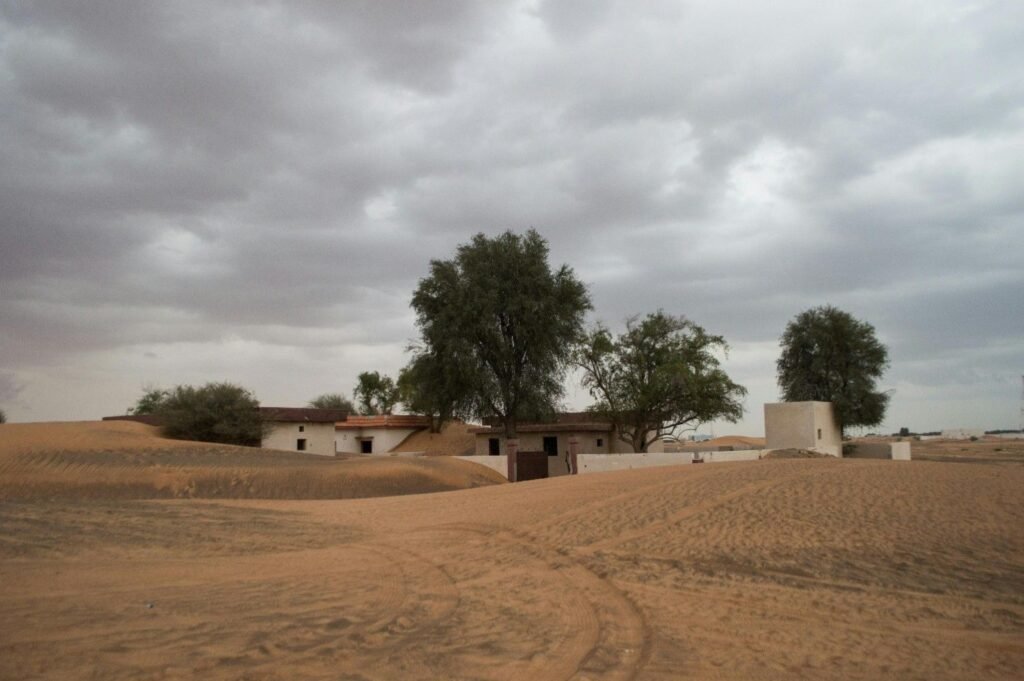
Most people go to Dubai for the skyscrapers, the shopping malls, the excess. Fair enough. But about an hour outside the city, the desert is quietly swallowing a ghost village — and almost nobody talks about it.
I stumbled on Al Madam by accident. A friend sent me a photo — sand pouring through a broken window, a child’s plastic chair half-buried in a dune, a mosque standing completely alone under a flat blue sky. I thought it was edited. It wasn’t.
That photo sent me down a rabbit hole. And eventually, it sent me to Al Madam itself. Here’s everything you need to know before you go — or before you decide you’re brave enough to.
So, What Is Al Madam?
Al Madam is a cluster of about 25 to 30 simple government-built houses in the Sharjah emirate, roughly 65 kilometres southeast of Dubai. The UAE government constructed it in the 1970s as part of an effort to give Bedouin tribes permanent housing — a way to settle nomadic communities and bring them into modern life.
It worked. Families moved in. They brought their furniture, their rugs, their prayer mats. Children played in the courtyards. The mosque held congregations.
Then, sometime in the mid-1990s, everyone left. Quickly. And they never came back.
No official explanation exists. No disaster, no recorded event. The residents simply vanished and left everything behind — as if they stepped out for an evening walk and never returned. The National News has covered it briefly, but even they couldn’t pin down a definitive reason for the exodus.
“The desert doesn’t erase things. It buries them. Al Madam is proof.”
What Theories Exist?
You’ll find a few theories floating around online. None are confirmed.
The most common one: djinn. In Emirati folklore, djinn — supernatural spirits — are taken seriously. Some locals say the village was haunted from the start. That unexplainable things happened at night. That the desert itself felt wrong there. Whether you believe that or not, the fact that this is the leading explanation tells you something.
A more practical theory suggests the sand was simply unliveable. The dunes in that region shift aggressively. Sand encroachment is a documented crisis across the Gulf — the UN Environment Programme has flagged it as a serious regional threat. Perhaps the community fought the sand for years, lost, and quietly relocated.
A third theory points to a water or infrastructure failure. Settlements in remote desert locations depend on government supply lines. If those broke down, life there would have become genuinely impossible within weeks.
The truth is probably a mix of all three. Whatever it was, nobody left a note.
Al Madam sits in the Sharjah emirate, not Dubai — though most visitors approach from Dubai. It’s near the town of Al Madam on the Dubai–Hatta Road. GPS coordinates: 24.9481° N, 55.7479° E. Drop a pin before you go — signal gets patchy.
What You’ll Actually See There
I want to be honest: it’s not manicured. There are no signs, no guided tours, no visitor centre. It’s a raw, open, slightly eerie cluster of abandoned buildings in the middle of the desert.
The sand has taken over. Some houses are buried to the windowsill. Others have dunes piled against the front door like the desert is trying to get in. You’ll push through a door — the kind that still has a handle, that still swings open — and step into a living room with a sofa still against the wall and sand an inch thick on every surface.
The mosque is the most striking thing. It stands relatively intact, the call-to-prayer speaker still mounted on the minaret, the courtyard half-filled with drifted sand. It feels deeply wrong in the best way — like a stage set no one bothered to clear.
Most furniture is gone now. Visitors over the years have taken things, which is unfortunate and also inevitable. But enough remains that the scene still hits you. You feel the presence of people who left in a hurry — or who left peacefully, intending to return, and just never did.
Why Ambitious Travellers Should Add This to Their Dubai Trip
Dubai rewards the curious. Most tourists do the Burj Khalifa, the gold souk, maybe a desert safari. All of that is worth doing. But Al Madam offers something different: a gap in the narrative. A question mark in a city built entirely on exclamation points.
The UAE’s story is one of rapid transformation — from a sparse, nomadic landscape to one of the world’s most ambitious urban experiments in under 50 years. Al Madam is what got left behind in that transformation. It’s the other side of the story.
If you’re the kind of traveller who reads beyond the highlights — who wants to understand a place, not just photograph it — this is your stop.
Before you go — practical notes
- Go early morning. By 9am the desert heat is uncomfortable. By noon it’s brutal.
- It’s free and open. No ticket, no gate, no official anything. Just show up.
- Rent a car. Public transport doesn’t go here. A standard sedan is fine — the road is paved.
- Wear closed shoes. Sand hides broken glass and rusted metal in abandoned buildings.
- Don’t take anything. Seriously. What’s left is already disappearing fast.
- Tell someone where you’re going. It’s not dangerous, but it’s remote.
- Combine it with a Hatta day trip — the mountains are another 45 minutes east and completely worth it.
The Feeling You Can’t Photograph
I’ve been to abandoned places before. Chernobyl exclusion zone. A ghost town in rural Portugal. A crumbling colonial hotel in Sri Lanka. Each one has its own atmosphere — its own specific quality of absence.
Al Madam feels different because of scale. It’s not a city. It’s 25 houses. That’s about 25 families. You can hold the whole community in your mind at once. You can stand in the middle of the village and see every home from one spot. That intimacy makes the abandonment feel personal in a way a larger ruin doesn’t.
Standing in a living room in that village — sand on the floor, a broken ceiling fan above, a single plastic sandal in the corner — I thought about the family who lived there. Whether they chose to leave or had to. Whether they ever looked back.
The desert doesn’t give you an answer. It just keeps burying the question.
That’s enough to make it worth the drive.
If you go, I’d love to hear what you find. The village changes — dunes shift, things disappear, the light falls differently in different seasons. No two visits are quite the same. Drop a comment below or tag me if you make it out there.